All of our energy comes from the sun. Solar powered lights offer a low cost and do not pollute the environment. Such lights are very popular for garden use and landscaping. They are hassle free. There are no cables to worry about or the possibility of being electrocuted.
Are solar powered lights right for your home? These lights produce an intense glow and shadowing around the surrounding areas. Solar powered lights are perfect for those applications where a regular power source is unavailable. The solar panel collects sunlight and converts electricity. The electricity is stored in rechargeable batteries. The lights will be strongest during the first few hours of operation and then slowly diminish in output.
There are many styles and brands of solar powered lights to choose from. They are inexpensive. They are designed to accent your home. Many choose this option because it is much cheaper that installing electricity to another area as well as the environmental impact. Most individuals can install solar powered lights easily by themselves. This again saves money over having a professional come to set up for electricity. The internet offers many reviews on brands of solar powered lights. It is a great resource for comparing cost and effectiveness of the products available.
Several towns have taken to installing solar powered lights as street lights. They are able to store up energy from the sun during the day and operate on that energy until early morning. The Solar Outdoor Lighting company donated and installed such lighting at the Ocala National Forest. Miami International Airport installed solar powered lights to offer additional security for their employees. They chose them for their low cost, environmental friendliness, the fact that they took a fifth of the time to install as regular lighting fixtures, and that they are going to be undergoing construction soon. The solar powered lights can be moved easily.
The biggest disadvantage of the solar powered lights is that they do require an adequate amount to sunlight to create the energy. If you have several days of cloudy weather, the lights may not operate effectively. This has affected the decision of some businesses. They feel if it is important enough to install lighting, then it needs to be reliable and available on a regular basis.
Selasa, 05 Februari 2008

Senin, 04 Februari 2008
cuba president

Fidel Alejandro Castro Ruz (born August 13, 1926) is the current President of Cuba, though due to illness, his duties have been transferred to his younger brother, Raúl Modesto Castro Ruz.
Castro led the revolution overthrowing Fulgencio Batista in 1959. Shortly thereafter, Castro was sworn in as the Prime Minister of Cuba.[1] Castro became First Secretary of the Communist Party of Cuba in 1965, and led the transformation of Cuba into a one-party socialist republic. In 1976 he became president of the Council of State as well as of the Council of Ministers. He also holds the supreme military rank of Comandante en Jefe ("Commander in Chief") of the Cuban armed forces.
Castro first attracted attention in Cuban political life through nationalist critiques of Batista and the United States political and corporate influence in Cuba. He gained an ardent, but limited, following and also drew the attention of the authorities.[2] He eventually led the failed 1953 attack on the Moncada Barracks, after which he was captured, tried, incarcerated and later released. He then travelled to Mexico[3][4] to organize and train for the guerrilla invasion of Cuba that took place in December 1956.
Since his assumption of power in 1959 he has evoked both praise and condemnation (at home and internationally). Opponents characterize Castro as a dictator, claiming that he has not risen to power through open, public elections, and some contend that his rule is illegitimate because the socialist system itself was not established through what they considered to be legal means.[5] Supporters, on the other hand, see Castro as a charismatic leader [6] whose presidential authority has been acquired through legitimate elections.[7]
Outside of Cuba, Castro has been defined by his relationship with the United States and the former Soviet Union, both of whom courted Cuban attentions as part of their own global political agenda. While Cuba's relations with countries of the Soviet bloc were generally cordial during the Cold War, the Castro-led government has had an antagonistic relationship with the United States since the failed Bay of Pigs invasion of Cuba in 1961 by U.S.-backed forces.
Following the collapse of the Soviet Union and Cuba's one major Latin American ally, Nicaragua, in the early 1990s, the Cuba government found itself in a precarious spot. However, in recent years, Castro has found new regional allies in Latin America. Regional Socialist and nationalist figures such as Hugo Chávez in Venezuela and Evo Morales in Bolivia have been ready allies. According to Paul Reynolds of the BBC, Fidel is a world icon,[8] and is the current Secretary-General of the Non-Aligned Movement (his second term in that office, the first having been 1979-1983).
At home, Fidel Castro has overseen the implementation of various economic policies, leading to the rapid centralization of Cuba's economy, land reform, collectivization and mechanization of agriculture, and the expropriation of leading Cuban industries. Opponents, claim that these changes have had disastrous consequences and transformed Cuba into a third-world nation[9], as Cuba's GDP has failed to keep up with countries that were in a similar position during the 1950s despite the generous subsidies of the Soviet Union until the 1990s.[10] Conversely, supporters attribute the U.S. embargo for some or all of Cuba's shortcomings, but maintain that Cuba's economy has expanded and grown at a more than acceptable rate since the revolution. In 2006, the Cuban government reported that Cuba achieved 12.5% growth,[11] which included trade and social services as part of GDP estimation; an unusual practice. Excluding those categories, which is the more conventional practice, economic growth is estimated to be at 9.5%.[12]
The expansion of publicly funded health care and education has been a cornerstone of Castro's domestic political program. Cuba ranks better than many countries on the United Nations' list of countries by infant mortality rate, which is claimed by Castro's supporters as a success of his government. Opponents claim that Cuba's health care and infant mortality were the same if not better before the revolution [13] and question the truthfulness of statistics concerning Cuba, despite its republication by the United Nations, World Health Organization, and Central Intelligence Agency, due to the fact that most of this data is collected, or assisted in the collection, by the Cuban government. [14]
Under Castro, particularly after the onset of the Special Period created by the collapse of the Soviet Union,[15] Cuba has experienced a severe housing shortage[16] and a decline in the quality of its public works.[17]
Moreover, opponents claim that there had been a significant decline in the average caloric intake since the Revolution came to power. [18] While true in the 1990's, due primarily to the lack of low-priced oil from the U.S.S.R., Castro's government rapidly began converting agriculture away from Soviet-style high mechanization towards "greener" methods of organic farming and urban agriculture in an effort to increase domestic consumption.[19]
On July 31, 2006, Castro, after undergoing intestinal surgery for diverticulitis,[20] transferred his responsibilities to the First Vice-President, his younger brother Raúl Castro. On June 2, 2007, Castro appeared on Cuban Television with Vietnamese Communist Party Leader Nong Duc Manh looking somewhat healthier.[21]
soeharto
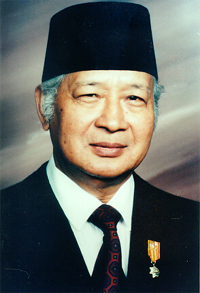
Suharto (June 8, 1921 – January 27, 2008) was an Indonesian military leader, and the second President of Indonesia, holding the office from 1967 to 1998.
Suharto was born in a small village near Yogyakarta, during the era of Dutch colonial control. His ethnic Javanese peasant parents divorced not long after his birth, and he was passed around several foster parents for much of his childhood. After a brief and an unsuccessful stint as a village bank clerk, Suharto joined the Royal Netherlands East Indies Army in 1940. During the Japanese occupation of Indonesia, Suharto served in various Japanese-organised Indonesian security forces. He joined the newly formed Indonesian army during Indonesia's independence struggle where he rose through the ranks to command a garrison against Dutch offensives at the Republican capital of Yogyakarta. Following Indonesian independence, Suharto rose to the rank of Major General.
An attempted coup on 30 September 1965 was countered by Suharto-led troops.[2] The Suharto-led army blamed the attempt on the Indonesian Communist Party, which was subsequently outlawed, and led a violent anti-communist purge that killed between 500,000 and one million people.[3] Suharto wrested power from the weakened incumbent, and founding president, Sukarno, and was inaugurated President in March 1968. Popular, military and political support in Indonesia for Suharto's 32-year presidency eroded dramatically following the devastating effect of the 1997-98 Asian financial crisis on Indonesia's economy and standard of living. Suharto was forced to resign from the presidency in May 1998 following mass demonstrations and violence.
The legacy of Suharto's 32-year presidency is debated both in Indonesia and abroad. Under his "New Order" administration, Suharto constructed a strong militarist centralised government. An ability to maintain stability over a sprawling and diverse Indonesia, and an avowedly anti-Communist stance, won him the economic and diplomatic support of the West during the Cold War. For most of his presidency, Indonesia experienced significant economic growth and industrialization,[4] dramatically improving health, education and living standards.[5] The "New Order" placed restrictions on the country's ethnic Chinese.[6] Against the backdrop of Cold War international relations, Suharto's "New Order" invasion of East Timor, and the subsequent 24-year occupation, resulted in an estimated minimum of 102,800 deaths.[7] By the 1990s, the New Order's authoritarianism and widespread corruption—estimates of Suharto family embezzlement range from US$1.5 billion and US$35 billion[8][9]—was a source of much discontent, and was referred as one of the world's most corrupt leaders.[10] Suharto lived his post-presidential years in near seclusion, and attempts to try him on charges of corruption and genocide failed due to his poor health.
Like many Javanese, Suharto had only one name.[9] In religious contexts, he is sometimes called “Haji” or “el-Haj Mohammed Suharto”, but this Islamic title is not part of his formal name or generally used. The spelling "Suharto" has been official in Indonesia since 1947 but the older spelling Soeharto is still frequently used.[9]
my face

Hello, I am Rizky, my full name is RIZKY IKHWANUSHAFA ASHIDDIQY. But you can call me Rizky. I study in Senior High school 24
I like football and music. My favorites football club are
And the last, I hope you can add comment to my blog to…. To the best.
Selasa, 22 Januari 2008
Video Podcasts
Video podcasts allow individuals to get information out all over the internet in no time with a very easy set up that costs nothing, or very little if you decide to have a site assistant help with getting your podcast set up. It allows a video and audio of information to be seen by others.
Podcasts are popping up all over the internet with information on research, movies, and other even political information. They most common types of podcasts are of short programs, music, books; most anything you want to have seen.
The site, www.youtube.com, is a compilation of podcasts individuals have posted. Some are of practical jokes, some of are drag racing, the possibilities are endless. Basically anything you can video tape, you can turn into a podcast.
Video podcasts are very simple to make. They involve recording your video, recording your audio, and transferring the entire segment into a MP3 file .That’s it. Such podcasts are replacing the standard profiles on online dating sites with a fun podcast of who that person is. It really gives the user an insight to that person that they wouldn’t get just reading written text.
One concern with video podcasts, are the content of some of them. Surprised parents have discovered their teens posting podcasts of them naked, masturbating, and in some cases having sex. This is another important reason that parents need to monitor what their children are doing, as well as considering placing the computer in an area where it is easily accessible, but where everyone can see what activities are taking place.
Video podcasts have added a new dimension to computer technology, both for work and pleasure. While the idea has only been around for a few years, it has caught on quickly. That is because it is easy to set up as well as easy to access video podcasts.
Podcasts are popping up all over the internet with information on research, movies, and other even political information. They most common types of podcasts are of short programs, music, books; most anything you want to have seen.
The site, www.youtube.com, is a compilation of podcasts individuals have posted. Some are of practical jokes, some of are drag racing, the possibilities are endless. Basically anything you can video tape, you can turn into a podcast.
Video podcasts are very simple to make. They involve recording your video, recording your audio, and transferring the entire segment into a MP3 file .That’s it. Such podcasts are replacing the standard profiles on online dating sites with a fun podcast of who that person is. It really gives the user an insight to that person that they wouldn’t get just reading written text.
One concern with video podcasts, are the content of some of them. Surprised parents have discovered their teens posting podcasts of them naked, masturbating, and in some cases having sex. This is another important reason that parents need to monitor what their children are doing, as well as considering placing the computer in an area where it is easily accessible, but where everyone can see what activities are taking place.
Video podcasts have added a new dimension to computer technology, both for work and pleasure. While the idea has only been around for a few years, it has caught on quickly. That is because it is easy to set up as well as easy to access video podcasts.
Food Allergies
Food allergies are among the most dangerous types of allergies out there. It is the result of the immune system not reacting properly to certain foods, or certain ingredients in foods. The most common food allergies are nuts, milk, and eggs. Some people just feel ill when they consume something they are allergic to. Others experience swelling in the face, and swelling in the body, closing air paths. Hives and rashes are also very common.
Peanut allergies are said to be the worst. Not only do they cause the most severe symptoms, peanut oil is used in so many foods that the number of items that the person has to avoid can be very long. Last year, a teenage girl died. She had gone to the library to study with friends. Her boyfriend had eaten a peanut butter sandwich after school before joining them. He gave her a goodbye kiss at the library, and the reaction from the peanut oil swelled her throat shut. While it sounds extremely, sadly such occurrences do take place.
Very young children can have food allergies. It is recommended that you attach a list of any food allergies securely to the diaper bag. This will be a constant reminder to friends, family, and childcare providers. It is important children with food allergies are aware of the reasons why they can’t have certain foods. This will remind them to make the right food choices at school. It is important that your child’s principal and teachers know about the allergies as well. Often there are class parties, and if your child is tempted to eat food they are allergic to, the teacher can remind them.
The internet is a wonderful place to find out about food allergies. The Food Allergy & Anaphylaxis Network has an excellent website full of information. The organization was formed in 1991. It has over 30,000 members including families, dietitians, nurses, physicians, school administrators, teachers, government staff, and members of the food and drug administration. This diverse group works together to educate about food allergies by providing accurate information and heightening awareness. They carefully monitor TV, newspapers, and the news channels to be sure accurate information is being released to the public. They also lobby for further research to be done in the area of food allergies.
While there is no cure for food allergies that we know of, properly learning about such food allergies and working with a qualified doctor can help you find ways to control them. It is important if you or a family member has a food allergy that you make it know to those you are frequently in contact with. This includes co-workers, family, friends, neighbors, and daycare providers. This will help them learn about the issue as well as be able to get medical attention to you if the situation arises. The fact that they are able to let medical professionals know you have such food allergies can make all the difference in h how fast they are able to administer treatment.
Peanut allergies are said to be the worst. Not only do they cause the most severe symptoms, peanut oil is used in so many foods that the number of items that the person has to avoid can be very long. Last year, a teenage girl died. She had gone to the library to study with friends. Her boyfriend had eaten a peanut butter sandwich after school before joining them. He gave her a goodbye kiss at the library, and the reaction from the peanut oil swelled her throat shut. While it sounds extremely, sadly such occurrences do take place.
Very young children can have food allergies. It is recommended that you attach a list of any food allergies securely to the diaper bag. This will be a constant reminder to friends, family, and childcare providers. It is important children with food allergies are aware of the reasons why they can’t have certain foods. This will remind them to make the right food choices at school. It is important that your child’s principal and teachers know about the allergies as well. Often there are class parties, and if your child is tempted to eat food they are allergic to, the teacher can remind them.
The internet is a wonderful place to find out about food allergies. The Food Allergy & Anaphylaxis Network has an excellent website full of information. The organization was formed in 1991. It has over 30,000 members including families, dietitians, nurses, physicians, school administrators, teachers, government staff, and members of the food and drug administration. This diverse group works together to educate about food allergies by providing accurate information and heightening awareness. They carefully monitor TV, newspapers, and the news channels to be sure accurate information is being released to the public. They also lobby for further research to be done in the area of food allergies.
While there is no cure for food allergies that we know of, properly learning about such food allergies and working with a qualified doctor can help you find ways to control them. It is important if you or a family member has a food allergy that you make it know to those you are frequently in contact with. This includes co-workers, family, friends, neighbors, and daycare providers. This will help them learn about the issue as well as be able to get medical attention to you if the situation arises. The fact that they are able to let medical professionals know you have such food allergies can make all the difference in h how fast they are able to administer treatment.
coffe
The history of coffee, while hard to verify to accuracy, legend a sheepherder who realized the effects of coffee while tending his sheep. His sheep became very active when they ate a certain type of berry off a plant. He tried them himself, and felt the same effect. Rumor has it that a monk told him to be careful of the devil’s fruit. However, it is also rumored that the monks used the fruit to stay awake and pray.
Another wide spread legend claims an Arabian was banished to the desert. He boiled and ate an unknown plant. He was able to survive in the desert on the plant. The residents of a town close by felt the survival was a religious sign. The plant was then named Mocha, after that town.
Few people realize the coffee plant originally grew only in Ethiopia. They wrapped it in animal fat to eat while on raids. It was transported to Arabia, it grew, and they controlled the market of it. The Turks then were the first to drink it. They added cinnamon and clove for a sweeter taste.
Coffee founds its way to Europe via the Venetian trade merchants. Rumors of the taste of coffee began to surface all over. The Arab’s keep an even tighter grip on the coffee plants. Christian’s began claiming coffee was the devil’s drink, similar to the monk story above. Pope Vincent III decided to try it. He enjoyed it very much. After that, talk of banishing the drink went away.
Soon after, coffee houses were built all over Europe. They became a popular place to hang out and drink coffee. It was in the 1700’s that coffee traveled to Americas. A French infantry captain took a small plant with him. That plant was cultivated, resulting in over 19 million coffee trees within 50 years. Coffee was declared the national drink of the United States in a protest of the excessive taxes on tea from Britain.
Today, millions of people enjoy their coffee throughout the day. Coffee comes in many brands and many flavors. You can buy ground coffee or coffee beans at most any grocery store. There are also gourmet coffees to choose from Businesses such as Starbuck’s Coffee are million dollar industries, offering you the convenience of coffee any way you want it.
Another wide spread legend claims an Arabian was banished to the desert. He boiled and ate an unknown plant. He was able to survive in the desert on the plant. The residents of a town close by felt the survival was a religious sign. The plant was then named Mocha, after that town.
Few people realize the coffee plant originally grew only in Ethiopia. They wrapped it in animal fat to eat while on raids. It was transported to Arabia, it grew, and they controlled the market of it. The Turks then were the first to drink it. They added cinnamon and clove for a sweeter taste.
Coffee founds its way to Europe via the Venetian trade merchants. Rumors of the taste of coffee began to surface all over. The Arab’s keep an even tighter grip on the coffee plants. Christian’s began claiming coffee was the devil’s drink, similar to the monk story above. Pope Vincent III decided to try it. He enjoyed it very much. After that, talk of banishing the drink went away.
Soon after, coffee houses were built all over Europe. They became a popular place to hang out and drink coffee. It was in the 1700’s that coffee traveled to Americas. A French infantry captain took a small plant with him. That plant was cultivated, resulting in over 19 million coffee trees within 50 years. Coffee was declared the national drink of the United States in a protest of the excessive taxes on tea from Britain.
Today, millions of people enjoy their coffee throughout the day. Coffee comes in many brands and many flavors. You can buy ground coffee or coffee beans at most any grocery store. There are also gourmet coffees to choose from Businesses such as Starbuck’s Coffee are million dollar industries, offering you the convenience of coffee any way you want it.
HISTORY OF BANDUNG
The earliest reference to the city dates back to 1488, but archaeological findings suggest a type of Homo erectus species had lived on the banks of the Cikapundung River and around the old lake of Bandung.[8] During the seventeenth and eighteenth centuries, the Dutch East Indies Company (VOC) opened plantations in the Bandung area. A supply road connecting Batavia (now Jakarta), Bogor, Cianjur, Bandung, Sumedang and Cirebon was built in 1786. In 1809, Louis Napoleon, the ruler of the Kingdom of the Netherlands and its colonies, ordered the Dutch Indies Governor H.W. Daendels to increase the defensive systems of Java against the British from India. Daendels built a road, stretching approximately 1,000 km (621 miles) from the west to the east coast of Java, and passing through Bandung.[9][10] In 1810, the road was laid down in Bandung and was named De Groote Postweg (or the 'main post road'), the present-day site of Asia-Afrika Street. Under Daendels' orders, R.A. Wiranatakusumah II, the chief administration of the Bandung regency at that time, moved its office from Krapyak, in the south, to a place near a pair of holy city wells (sumur Bandung), the present-day site of the city square (alun-alun). He built his dalem (palace), masjid agung (the grand mosque) and pendopo (public-official meeting place) in the classical orientation.[11] The pendopo faces Tangkuban Perahu mountain, which was believed to have a mystical ambience.
In 1880, the first major railroad between Batavia and Bandung was built,[12] boosting light industry in Bandung. Chinese who had previously never lived in the city flocked to help run facilities, services and selling vendor machines. The old Chinatown district in Bandung is still recognisable in the railroad station vicinity. In 1906, Bandung was given the status of gemeente (municipality) and then later as stadsgemeente (city municipality) in 1926.
In the beginning of the 1920s, the Dutch East Indies government made plans to move the capital of Dutch East Indies from Batavia to Bandung. Accordingly, during this decade, the Dutch colonial government started building military barracks, the central government building (Gouvernments Bedrijven, the present-day Gedung Sate) and other government buildings. This plan, however, was cut short by World War II after which the Dutch were not able to re-established their colony.
The fertile area of the Parahyangan Mountains surrounding Bandung supports productive tea plantations. In the nineteenth century, Franz Junghuhn introduced the cinchona (kina) plant.[13] With its cooler elevated landscape, surrounded by major plantations, Bandung became an exclusive European resort area.[14] Rich plantation owners visited the city on weekends, attracting girls and businessmen from the capital, Batavia. Braga Street grew into a promenade street with cafes, restaurants and boutique shops. Two art-deco style hotels, Savoy Homann and Preanger, were built in the vicinity of the Concordia Society, a club house for the wealthy with a large ballroom and a theatre.[12] The nickname "Parijs van Java" was given to the city.
Gedung Merdeka during the Asian-African Conference in 1955
After the Indonesian Independence in 1945, Bandung was determined as the capital of West Java province. During the 1945–1949 independence struggle against the Dutch when they wanted to reclaim their colonies, Bandung was one of the heaviest battle places. The Dutch military commander set an ultimatum for the Indonesian combatants in Bandung to leave the city. In response, on 24 March 1946, much of the southern part of Bandung was deliberately set alight as the combatants left; an event known as the Bandung Lautan Api or 'Bandung Sea of Flame'.[15]
In 1955, the first Asian-African Conference was held in Bandung, attended by head of states representing twenty-nine countries and colonies from Asia and Africa. The conference venue was at the Gedung Merdeka, the former Concordia Society building. The conference announced 10 points of declaration on world peace promotion and oppositions against colonialism, known as the Declaration of Bandung, which followed by wave of nationalism movements around the globe and remapped the world politics.[16] The conference was also the first international conference of colored people in the history of mankind.[17] Richard Wright in his book, The Color Curtain, captured the epic meanings of the conference for people of color around the world.[17] Even black freedom movement activists in the United States referred Bandung as Afro-Asian solidarity in 1960s.[18]
In 1987, the city boundary was expanded with the Greater Bandung (Bandung Raya) plan; a relocation of higher concentration development outside the city in an attempt to dilute some of population in the old city. During its development, however, the city core is often uprooted, old faces are torn down, lot sizes regrouped, and what was idyllic residence is bustling chain supermarkets and rich banks.
In 1880, the first major railroad between Batavia and Bandung was built,[12] boosting light industry in Bandung. Chinese who had previously never lived in the city flocked to help run facilities, services and selling vendor machines. The old Chinatown district in Bandung is still recognisable in the railroad station vicinity. In 1906, Bandung was given the status of gemeente (municipality) and then later as stadsgemeente (city municipality) in 1926.
In the beginning of the 1920s, the Dutch East Indies government made plans to move the capital of Dutch East Indies from Batavia to Bandung. Accordingly, during this decade, the Dutch colonial government started building military barracks, the central government building (Gouvernments Bedrijven, the present-day Gedung Sate) and other government buildings. This plan, however, was cut short by World War II after which the Dutch were not able to re-established their colony.
The fertile area of the Parahyangan Mountains surrounding Bandung supports productive tea plantations. In the nineteenth century, Franz Junghuhn introduced the cinchona (kina) plant.[13] With its cooler elevated landscape, surrounded by major plantations, Bandung became an exclusive European resort area.[14] Rich plantation owners visited the city on weekends, attracting girls and businessmen from the capital, Batavia. Braga Street grew into a promenade street with cafes, restaurants and boutique shops. Two art-deco style hotels, Savoy Homann and Preanger, were built in the vicinity of the Concordia Society, a club house for the wealthy with a large ballroom and a theatre.[12] The nickname "Parijs van Java" was given to the city.
Gedung Merdeka during the Asian-African Conference in 1955
After the Indonesian Independence in 1945, Bandung was determined as the capital of West Java province. During the 1945–1949 independence struggle against the Dutch when they wanted to reclaim their colonies, Bandung was one of the heaviest battle places. The Dutch military commander set an ultimatum for the Indonesian combatants in Bandung to leave the city. In response, on 24 March 1946, much of the southern part of Bandung was deliberately set alight as the combatants left; an event known as the Bandung Lautan Api or 'Bandung Sea of Flame'.[15]
In 1955, the first Asian-African Conference was held in Bandung, attended by head of states representing twenty-nine countries and colonies from Asia and Africa. The conference venue was at the Gedung Merdeka, the former Concordia Society building. The conference announced 10 points of declaration on world peace promotion and oppositions against colonialism, known as the Declaration of Bandung, which followed by wave of nationalism movements around the globe and remapped the world politics.[16] The conference was also the first international conference of colored people in the history of mankind.[17] Richard Wright in his book, The Color Curtain, captured the epic meanings of the conference for people of color around the world.[17] Even black freedom movement activists in the United States referred Bandung as Afro-Asian solidarity in 1960s.[18]
In 1987, the city boundary was expanded with the Greater Bandung (Bandung Raya) plan; a relocation of higher concentration development outside the city in an attempt to dilute some of population in the old city. During its development, however, the city core is often uprooted, old faces are torn down, lot sizes regrouped, and what was idyllic residence is bustling chain supermarkets and rich banks.
Bandung
Bandung (pronounced [bʌndʊŋ]) is the capital of West Java province in Indonesia, and the country's fourth largest city. Located 768 m (2,520 ft) above sea level, Bandung has relatively year-around cooler temperature than most other Indonesian cities. The city lies on a river basin and surrounded by volcanic mountains. This topology provides the city with a good natural defense system, which was the primary reason of Dutch East Indies government's plan to move the colony capital from Batavia to Bandung.
The Dutch colonials first opened tea plantantions around the mountains in the eighteenth century, followed by a road construction connecting the plantation area to the capital (180 km or 112 miles to the northwest). The European inhabitants of the city demanded the establishment of a municipality (gemeente), which was granted in 1906 and Bandung gradually developed itself into a resort city for the plantation owners. Luxurious hotels, restaurants, cafes and European boutiques were opened of which the city was dubbed as Parijs van Java.
After Indonesian independence, the city experienced a rapid development and urbanization that has transformed Bandung from idyllic town into a dense 15,000 people/Geography
Mount Tangkuban Perahu
Bandung, the capital of West Java province, is located about 180 km (112 miles) southeast of Jakarta. Its elevation is 768 metres (2,520 ft) above sea level and is surrounded by up to 2,400 m (7,874 ft) high Late Tertiary and Quarternary volcanic terrain.[1] The 400 km² flat of central Bandung plain is situated in the middle of 2,340.88 km² wide of the Bandung Basin; the basin comprises Bandung, the Cimahi satellite city, part of Bandung Regency, and part of Sumedang Regency.[2] The basin's main river is the Citarum; one of its branches, the Cikapundung, divides Bandung from north to south before it merges with Citarum again in Karawang. The Bandung Basin is an important source of water for drinking water, irrigation and fisheries, and its 6,147 million m³ of groundwater is a major reservoir for the city.[2]
The northern part of the city is hillier than the rest; the distinguished truncated flat-peak shape of the Tangkuban Perahu volcano (Tangkuban Perahu literally means 'up-turned boat') can be seen from the city to the north. Long-term volcanic activity has created fertile andisol soil in the north, suitable for intensive rice, fruit, tea, tobacco and coffee plantations. In the south and east, alluvial soils deposited by the Cikapundung river are mostly found.
Geological data shows that the Bandung Basin is located on an ancient volcano, known as Mount Sunda, erected up to 3,000–4,000 metres (9,850–13,100 ft) during the Pleistocene age.[3] Two large scale eruptions took place; the first formed the basin and the other (est. 55,000 Before Present) blocked the Citarum river, turning the basin into a lake known as "the Great Lake of Bandung".[4] The lake drained away; the reason for which is the subject of ongoing debate among geologists.[5][6]
Due to its elevation, the climate in Bandung is cooler than most Indonesian cities and can be classified as humid; the average temperature is 23.6 °C (74.5 °F) throughout the year.[7] The average annual rainfall ranges from 1,000 millimetres in the central and southeast regions to 3,500 millimetres in the north of the city.[2] The wet season conforms with other Indonesian regions, around November to Aprikm² metropolitan area, a living space for over 2 million people. Natural resources have been exploited excessively, particularly in the conversions of protected upland area into highland villa and real estates. Although the city has encountered many problems, ranging from waste disposal, floods to chaotic traffic system, Bandung however still has its charm to attract people flocking into the city, either as weekend travellers or living in.
The Dutch colonials first opened tea plantantions around the mountains in the eighteenth century, followed by a road construction connecting the plantation area to the capital (180 km or 112 miles to the northwest). The European inhabitants of the city demanded the establishment of a municipality (gemeente), which was granted in 1906 and Bandung gradually developed itself into a resort city for the plantation owners. Luxurious hotels, restaurants, cafes and European boutiques were opened of which the city was dubbed as Parijs van Java.
After Indonesian independence, the city experienced a rapid development and urbanization that has transformed Bandung from idyllic town into a dense 15,000 people/Geography
Mount Tangkuban Perahu
Bandung, the capital of West Java province, is located about 180 km (112 miles) southeast of Jakarta. Its elevation is 768 metres (2,520 ft) above sea level and is surrounded by up to 2,400 m (7,874 ft) high Late Tertiary and Quarternary volcanic terrain.[1] The 400 km² flat of central Bandung plain is situated in the middle of 2,340.88 km² wide of the Bandung Basin; the basin comprises Bandung, the Cimahi satellite city, part of Bandung Regency, and part of Sumedang Regency.[2] The basin's main river is the Citarum; one of its branches, the Cikapundung, divides Bandung from north to south before it merges with Citarum again in Karawang. The Bandung Basin is an important source of water for drinking water, irrigation and fisheries, and its 6,147 million m³ of groundwater is a major reservoir for the city.[2]
The northern part of the city is hillier than the rest; the distinguished truncated flat-peak shape of the Tangkuban Perahu volcano (Tangkuban Perahu literally means 'up-turned boat') can be seen from the city to the north. Long-term volcanic activity has created fertile andisol soil in the north, suitable for intensive rice, fruit, tea, tobacco and coffee plantations. In the south and east, alluvial soils deposited by the Cikapundung river are mostly found.
Geological data shows that the Bandung Basin is located on an ancient volcano, known as Mount Sunda, erected up to 3,000–4,000 metres (9,850–13,100 ft) during the Pleistocene age.[3] Two large scale eruptions took place; the first formed the basin and the other (est. 55,000 Before Present) blocked the Citarum river, turning the basin into a lake known as "the Great Lake of Bandung".[4] The lake drained away; the reason for which is the subject of ongoing debate among geologists.[5][6]
Due to its elevation, the climate in Bandung is cooler than most Indonesian cities and can be classified as humid; the average temperature is 23.6 °C (74.5 °F) throughout the year.[7] The average annual rainfall ranges from 1,000 millimetres in the central and southeast regions to 3,500 millimetres in the north of the city.[2] The wet season conforms with other Indonesian regions, around November to Aprikm² metropolitan area, a living space for over 2 million people. Natural resources have been exploited excessively, particularly in the conversions of protected upland area into highland villa and real estates. Although the city has encountered many problems, ranging from waste disposal, floods to chaotic traffic system, Bandung however still has its charm to attract people flocking into the city, either as weekend travellers or living in.
Jairzinho
Jairzinho, birth name Jair Ventura Filho, (born December 25, 1944) is a former Brazilian footballer. A quick, powerful winger, he was a member of the legendary Brazilian national team that won the 1970 FIFA World Cup, during which he scored in every game Brazil played. In doing so, he became the only player in the history of the World Cup to have scored in every game of the tournament.[2] He played most of his club football in South America, where he spent eleven years at Botafogo in Rio de Janeiro. He replaced his footballing idol Garrincha in both the Botafogo and Brazil teams, and played in three consecutive World Cups.
Despite his reputation as one of the finest players in Brazil's 1970 World Cup team, he was controversially omitted from the FIFA 100 listBiography
Jairzinho was born in Rio de Janeiro, where he went through the youth setup at local club Botafogo. He made his professional debut with the club as a striker at the age of fifteen. His hero Garrincha, whom he would eventually replace for both club and country, also played at Botafogo, albeit in Jairzinho's preferred position on the right wing. This resulted in Jairzinho spending most of his early games playing on the left wing or as a centre forward. However, he would fill in as a right winger, by far his strongest position, when Garrincha was injured.
He made his international debut as a 19 year old in 1964 against Portugal, again when Garrincha was injured. He played in the 1966 FIFA World Cup in England, however, and with Garrincha back in the side, he played as a left winger. Jairzinho struggled to be effective in this position, and he couldn't prevent Brazil from exiting the competition at the first round. When, after the tournament, Garrincha announced his retirement from international football, Jairzinho finally took over his idol's role for Brazil on the right wing.
Now in his favourite position, Jairzinho could at last reveal his immense talent to the world. At the 1970 FIFA World Cup in Mexico, Jairzinho was one of Brazil's star players, and made history by scoring in every game for the Seleção. He scored his seventh goal of the tournament in Brazil's 4-1 defeat of Italy in the final. However, his impressive goals tally at the finals were not enough to win the Golden Boot, which went to Germany's Gerd Müller, who scored ten goals. Unsurprisingly, following his display in Mexico Jairzinho moved to Europe to play for French side Marseille. However, he struggled with Marseille and soon returned to Brazil to play for Cruzeiro, with whom he won the Libertadores Cup in 1976. The Cruzeiro team at time included the likes of Nelinho and Dirceu Lopes.
Jairzinho scored two goals in the 1974 FIFA World Cup, which would prove to be his last World Cup for Brazil. He did, however, continue to play for Brazil for another eight years. His final game was on March 3, 1982 against Czechoslovakia in a game which Brazil drew 1-1. He scored 33 goals in 82 games during his international career.
Jairzinho finished his career playing for Portuguesa in Venezuela. Following his retirement Jairzinho became a coach and coached the Gabon national team. However, Jairzinho was sacked by Gabon's Football Federation after a crushing defeat against Angola in a World Cup 2006 Qualifier held in Luanda. Perhaps his greatest achievement as a coach was spotting Ronaldo as a 14 year old whilst he was coaching São Cristóvão. He kick-started the career of the future three-time FIFA World Player of the Year by recommending him to Cruzeiro, his former side, and the Brazil youth team.[citation needed], compiled by his forme
Despite his reputation as one of the finest players in Brazil's 1970 World Cup team, he was controversially omitted from the FIFA 100 listBiography
Jairzinho was born in Rio de Janeiro, where he went through the youth setup at local club Botafogo. He made his professional debut with the club as a striker at the age of fifteen. His hero Garrincha, whom he would eventually replace for both club and country, also played at Botafogo, albeit in Jairzinho's preferred position on the right wing. This resulted in Jairzinho spending most of his early games playing on the left wing or as a centre forward. However, he would fill in as a right winger, by far his strongest position, when Garrincha was injured.
He made his international debut as a 19 year old in 1964 against Portugal, again when Garrincha was injured. He played in the 1966 FIFA World Cup in England, however, and with Garrincha back in the side, he played as a left winger. Jairzinho struggled to be effective in this position, and he couldn't prevent Brazil from exiting the competition at the first round. When, after the tournament, Garrincha announced his retirement from international football, Jairzinho finally took over his idol's role for Brazil on the right wing.
Now in his favourite position, Jairzinho could at last reveal his immense talent to the world. At the 1970 FIFA World Cup in Mexico, Jairzinho was one of Brazil's star players, and made history by scoring in every game for the Seleção. He scored his seventh goal of the tournament in Brazil's 4-1 defeat of Italy in the final. However, his impressive goals tally at the finals were not enough to win the Golden Boot, which went to Germany's Gerd Müller, who scored ten goals. Unsurprisingly, following his display in Mexico Jairzinho moved to Europe to play for French side Marseille. However, he struggled with Marseille and soon returned to Brazil to play for Cruzeiro, with whom he won the Libertadores Cup in 1976. The Cruzeiro team at time included the likes of Nelinho and Dirceu Lopes.
Jairzinho scored two goals in the 1974 FIFA World Cup, which would prove to be his last World Cup for Brazil. He did, however, continue to play for Brazil for another eight years. His final game was on March 3, 1982 against Czechoslovakia in a game which Brazil drew 1-1. He scored 33 goals in 82 games during his international career.
Jairzinho finished his career playing for Portuguesa in Venezuela. Following his retirement Jairzinho became a coach and coached the Gabon national team. However, Jairzinho was sacked by Gabon's Football Federation after a crushing defeat against Angola in a World Cup 2006 Qualifier held in Luanda. Perhaps his greatest achievement as a coach was spotting Ronaldo as a 14 year old whilst he was coaching São Cristóvão. He kick-started the career of the future three-time FIFA World Player of the Year by recommending him to Cruzeiro, his former side, and the Brazil youth team.[citation needed], compiled by his forme
Jairzinho
Jairzinho, birth name Jair Ventura Filho, (born December 25, 1944) is a former Brazilian footballer. A quick, powerful winger, he was a member of the legendary Brazilian national team that won the 1970 FIFA World Cup, during which he scored in every game Brazil played. In doing so, he became the only player in the history of the World Cup to have scored in every game of the tournament.[2] He played most of his club football in South America, where he spent eleven years at Botafogo in Rio de Janeiro. He replaced his footballing idol Garrincha in both the Botafogo and Brazil teams, and played in three consecutive World Cups.
Despite his reputation as one of the finest players in Brazil's 1970 World Cup team, he was controversially omitted from the FIFA 100 listBiography
Jairzinho was born in Rio de Janeiro, where he went through the youth setup at local club Botafogo. He made his professional debut with the club as a striker at the age of fifteen. His hero Garrincha, whom he would eventually replace for both club and country, also played at Botafogo, albeit in Jairzinho's preferred position on the right wing. This resulted in Jairzinho spending most of his early games playing on the left wing or as a centre forward. However, he would fill in as a right winger, by far his strongest position, when Garrincha was injured.
He made his international debut as a 19 year old in 1964 against Portugal, again when Garrincha was injured. He played in the 1966 FIFA World Cup in England, however, and with Garrincha back in the side, he played as a left winger. Jairzinho struggled to be effective in this position, and he couldn't prevent Brazil from exiting the competition at the first round. When, after the tournament, Garrincha announced his retirement from international football, Jairzinho finally took over his idol's role for Brazil on the right wing.
Now in his favourite position, Jairzinho could at last reveal his immense talent to the world. At the 1970 FIFA World Cup in Mexico, Jairzinho was one of Brazil's star players, and made history by scoring in every game for the Seleção. He scored his seventh goal of the tournament in Brazil's 4-1 defeat of Italy in the final. However, his impressive goals tally at the finals were not enough to win the Golden Boot, which went to Germany's Gerd Müller, who scored ten goals. Unsurprisingly, following his display in Mexico Jairzinho moved to Europe to play for French side Marseille. However, he struggled with Marseille and soon returned to Brazil to play for Cruzeiro, with whom he won the Libertadores Cup in 1976. The Cruzeiro team at time included the likes of Nelinho and Dirceu Lopes.
Jairzinho scored two goals in the 1974 FIFA World Cup, which would prove to be his last World Cup for Brazil. He did, however, continue to play for Brazil for another eight years. His final game was on March 3, 1982 against Czechoslovakia in a game which Brazil drew 1-1. He scored 33 goals in 82 games during his international career.
Jairzinho finished his career playing for Portuguesa in Venezuela. Following his retirement Jairzinho became a coach and coached the Gabon national team. However, Jairzinho was sacked by Gabon's Football Federation after a crushing defeat against Angola in a World Cup 2006 Qualifier held in Luanda. Perhaps his greatest achievement as a coach was spotting Ronaldo as a 14 year old whilst he was coaching São Cristóvão. He kick-started the career of the future three-time FIFA World Player of the Year by recommending him to Cruzeiro, his former side, and the Brazil youth team.[citation needed], compiled by his forme
Despite his reputation as one of the finest players in Brazil's 1970 World Cup team, he was controversially omitted from the FIFA 100 listBiography
Jairzinho was born in Rio de Janeiro, where he went through the youth setup at local club Botafogo. He made his professional debut with the club as a striker at the age of fifteen. His hero Garrincha, whom he would eventually replace for both club and country, also played at Botafogo, albeit in Jairzinho's preferred position on the right wing. This resulted in Jairzinho spending most of his early games playing on the left wing or as a centre forward. However, he would fill in as a right winger, by far his strongest position, when Garrincha was injured.
He made his international debut as a 19 year old in 1964 against Portugal, again when Garrincha was injured. He played in the 1966 FIFA World Cup in England, however, and with Garrincha back in the side, he played as a left winger. Jairzinho struggled to be effective in this position, and he couldn't prevent Brazil from exiting the competition at the first round. When, after the tournament, Garrincha announced his retirement from international football, Jairzinho finally took over his idol's role for Brazil on the right wing.
Now in his favourite position, Jairzinho could at last reveal his immense talent to the world. At the 1970 FIFA World Cup in Mexico, Jairzinho was one of Brazil's star players, and made history by scoring in every game for the Seleção. He scored his seventh goal of the tournament in Brazil's 4-1 defeat of Italy in the final. However, his impressive goals tally at the finals were not enough to win the Golden Boot, which went to Germany's Gerd Müller, who scored ten goals. Unsurprisingly, following his display in Mexico Jairzinho moved to Europe to play for French side Marseille. However, he struggled with Marseille and soon returned to Brazil to play for Cruzeiro, with whom he won the Libertadores Cup in 1976. The Cruzeiro team at time included the likes of Nelinho and Dirceu Lopes.
Jairzinho scored two goals in the 1974 FIFA World Cup, which would prove to be his last World Cup for Brazil. He did, however, continue to play for Brazil for another eight years. His final game was on March 3, 1982 against Czechoslovakia in a game which Brazil drew 1-1. He scored 33 goals in 82 games during his international career.
Jairzinho finished his career playing for Portuguesa in Venezuela. Following his retirement Jairzinho became a coach and coached the Gabon national team. However, Jairzinho was sacked by Gabon's Football Federation after a crushing defeat against Angola in a World Cup 2006 Qualifier held in Luanda. Perhaps his greatest achievement as a coach was spotting Ronaldo as a 14 year old whilst he was coaching São Cristóvão. He kick-started the career of the future three-time FIFA World Player of the Year by recommending him to Cruzeiro, his former side, and the Brazil youth team.[citation needed], compiled by his forme
pitch
Standard pitch measurements (See Imperial version)
Main article: Football pitch
As the Laws were formulated in England, and were initially administered solely by the four British football associations within IFAB, the standard dimensions of a football pitch were originally expressed in imperial units. The Laws now express dimensions with approximate metric equivalents (followed by traditional units in brackets), though popular use tends to continue to use traditional units in English-speaking countries with a relatively recent history of metrification, such as Britain.[25]
The length of the pitch for international adult matches is in the range 100–110 m (110–120 yd) and the width is in the range 64–75 m (70–80 yd). Fields for non-international matches may be 91–120 m (100–130 yd) length and 45–91 m (50–101 yd) in width, provided that the pitch does not become square. The longer boundary lines are touchlines or sidelines, while the shorter boundaries (on which the goals are placed) are goal lines. A rectangular goal is positioned at the middle of each goal line.[26] The inner edges of the vertical goal posts must be 7.3 m (8 yd) apart, and the lower edge of the horizontal crossbar supported by the goal posts must be 2.44 m (8 ft) above the ground. Nets are usually placed behind the goal, but are not required by the Laws.[27]
In front of each goal is an area known as the penalty area. This area is marked by the goal line, two lines starting on the goal line 16.5 m (18 yd) from the goalposts and extending 16.5 m (18 md) into the pitch perpendicular to the goal-line, and a line joining them. This area has a number of functions, the most prominent being to mark where the goalkeeper may handle the ball and where a penalty foul by a member of the defending team becomes punishable by a penalty kick. Other markings define the position of the ball or players at kick-offs, goal kicks, penalty kicks and corner kicks.[28]
Langganan:
Postingan (Atom)


