All of our energy comes from the sun. Solar powered lights offer a low cost and do not pollute the environment. Such lights are very popular for garden use and landscaping. They are hassle free. There are no cables to worry about or the possibility of being electrocuted.
Are solar powered lights right for your home? These lights produce an intense glow and shadowing around the surrounding areas. Solar powered lights are perfect for those applications where a regular power source is unavailable. The solar panel collects sunlight and converts electricity. The electricity is stored in rechargeable batteries. The lights will be strongest during the first few hours of operation and then slowly diminish in output.
There are many styles and brands of solar powered lights to choose from. They are inexpensive. They are designed to accent your home. Many choose this option because it is much cheaper that installing electricity to another area as well as the environmental impact. Most individuals can install solar powered lights easily by themselves. This again saves money over having a professional come to set up for electricity. The internet offers many reviews on brands of solar powered lights. It is a great resource for comparing cost and effectiveness of the products available.
Several towns have taken to installing solar powered lights as street lights. They are able to store up energy from the sun during the day and operate on that energy until early morning. The Solar Outdoor Lighting company donated and installed such lighting at the Ocala National Forest. Miami International Airport installed solar powered lights to offer additional security for their employees. They chose them for their low cost, environmental friendliness, the fact that they took a fifth of the time to install as regular lighting fixtures, and that they are going to be undergoing construction soon. The solar powered lights can be moved easily.
The biggest disadvantage of the solar powered lights is that they do require an adequate amount to sunlight to create the energy. If you have several days of cloudy weather, the lights may not operate effectively. This has affected the decision of some businesses. They feel if it is important enough to install lighting, then it needs to be reliable and available on a regular basis.
Selasa, 05 Februari 2008

Senin, 04 Februari 2008
cuba president

Fidel Alejandro Castro Ruz (born August 13, 1926) is the current President of Cuba, though due to illness, his duties have been transferred to his younger brother, Raúl Modesto Castro Ruz.
Castro led the revolution overthrowing Fulgencio Batista in 1959. Shortly thereafter, Castro was sworn in as the Prime Minister of Cuba.[1] Castro became First Secretary of the Communist Party of Cuba in 1965, and led the transformation of Cuba into a one-party socialist republic. In 1976 he became president of the Council of State as well as of the Council of Ministers. He also holds the supreme military rank of Comandante en Jefe ("Commander in Chief") of the Cuban armed forces.
Castro first attracted attention in Cuban political life through nationalist critiques of Batista and the United States political and corporate influence in Cuba. He gained an ardent, but limited, following and also drew the attention of the authorities.[2] He eventually led the failed 1953 attack on the Moncada Barracks, after which he was captured, tried, incarcerated and later released. He then travelled to Mexico[3][4] to organize and train for the guerrilla invasion of Cuba that took place in December 1956.
Since his assumption of power in 1959 he has evoked both praise and condemnation (at home and internationally). Opponents characterize Castro as a dictator, claiming that he has not risen to power through open, public elections, and some contend that his rule is illegitimate because the socialist system itself was not established through what they considered to be legal means.[5] Supporters, on the other hand, see Castro as a charismatic leader [6] whose presidential authority has been acquired through legitimate elections.[7]
Outside of Cuba, Castro has been defined by his relationship with the United States and the former Soviet Union, both of whom courted Cuban attentions as part of their own global political agenda. While Cuba's relations with countries of the Soviet bloc were generally cordial during the Cold War, the Castro-led government has had an antagonistic relationship with the United States since the failed Bay of Pigs invasion of Cuba in 1961 by U.S.-backed forces.
Following the collapse of the Soviet Union and Cuba's one major Latin American ally, Nicaragua, in the early 1990s, the Cuba government found itself in a precarious spot. However, in recent years, Castro has found new regional allies in Latin America. Regional Socialist and nationalist figures such as Hugo Chávez in Venezuela and Evo Morales in Bolivia have been ready allies. According to Paul Reynolds of the BBC, Fidel is a world icon,[8] and is the current Secretary-General of the Non-Aligned Movement (his second term in that office, the first having been 1979-1983).
At home, Fidel Castro has overseen the implementation of various economic policies, leading to the rapid centralization of Cuba's economy, land reform, collectivization and mechanization of agriculture, and the expropriation of leading Cuban industries. Opponents, claim that these changes have had disastrous consequences and transformed Cuba into a third-world nation[9], as Cuba's GDP has failed to keep up with countries that were in a similar position during the 1950s despite the generous subsidies of the Soviet Union until the 1990s.[10] Conversely, supporters attribute the U.S. embargo for some or all of Cuba's shortcomings, but maintain that Cuba's economy has expanded and grown at a more than acceptable rate since the revolution. In 2006, the Cuban government reported that Cuba achieved 12.5% growth,[11] which included trade and social services as part of GDP estimation; an unusual practice. Excluding those categories, which is the more conventional practice, economic growth is estimated to be at 9.5%.[12]
The expansion of publicly funded health care and education has been a cornerstone of Castro's domestic political program. Cuba ranks better than many countries on the United Nations' list of countries by infant mortality rate, which is claimed by Castro's supporters as a success of his government. Opponents claim that Cuba's health care and infant mortality were the same if not better before the revolution [13] and question the truthfulness of statistics concerning Cuba, despite its republication by the United Nations, World Health Organization, and Central Intelligence Agency, due to the fact that most of this data is collected, or assisted in the collection, by the Cuban government. [14]
Under Castro, particularly after the onset of the Special Period created by the collapse of the Soviet Union,[15] Cuba has experienced a severe housing shortage[16] and a decline in the quality of its public works.[17]
Moreover, opponents claim that there had been a significant decline in the average caloric intake since the Revolution came to power. [18] While true in the 1990's, due primarily to the lack of low-priced oil from the U.S.S.R., Castro's government rapidly began converting agriculture away from Soviet-style high mechanization towards "greener" methods of organic farming and urban agriculture in an effort to increase domestic consumption.[19]
On July 31, 2006, Castro, after undergoing intestinal surgery for diverticulitis,[20] transferred his responsibilities to the First Vice-President, his younger brother Raúl Castro. On June 2, 2007, Castro appeared on Cuban Television with Vietnamese Communist Party Leader Nong Duc Manh looking somewhat healthier.[21]
soeharto
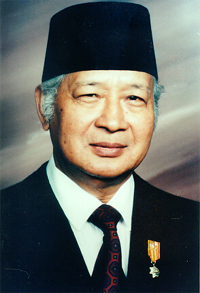
Suharto (June 8, 1921 – January 27, 2008) was an Indonesian military leader, and the second President of Indonesia, holding the office from 1967 to 1998.
Suharto was born in a small village near Yogyakarta, during the era of Dutch colonial control. His ethnic Javanese peasant parents divorced not long after his birth, and he was passed around several foster parents for much of his childhood. After a brief and an unsuccessful stint as a village bank clerk, Suharto joined the Royal Netherlands East Indies Army in 1940. During the Japanese occupation of Indonesia, Suharto served in various Japanese-organised Indonesian security forces. He joined the newly formed Indonesian army during Indonesia's independence struggle where he rose through the ranks to command a garrison against Dutch offensives at the Republican capital of Yogyakarta. Following Indonesian independence, Suharto rose to the rank of Major General.
An attempted coup on 30 September 1965 was countered by Suharto-led troops.[2] The Suharto-led army blamed the attempt on the Indonesian Communist Party, which was subsequently outlawed, and led a violent anti-communist purge that killed between 500,000 and one million people.[3] Suharto wrested power from the weakened incumbent, and founding president, Sukarno, and was inaugurated President in March 1968. Popular, military and political support in Indonesia for Suharto's 32-year presidency eroded dramatically following the devastating effect of the 1997-98 Asian financial crisis on Indonesia's economy and standard of living. Suharto was forced to resign from the presidency in May 1998 following mass demonstrations and violence.
The legacy of Suharto's 32-year presidency is debated both in Indonesia and abroad. Under his "New Order" administration, Suharto constructed a strong militarist centralised government. An ability to maintain stability over a sprawling and diverse Indonesia, and an avowedly anti-Communist stance, won him the economic and diplomatic support of the West during the Cold War. For most of his presidency, Indonesia experienced significant economic growth and industrialization,[4] dramatically improving health, education and living standards.[5] The "New Order" placed restrictions on the country's ethnic Chinese.[6] Against the backdrop of Cold War international relations, Suharto's "New Order" invasion of East Timor, and the subsequent 24-year occupation, resulted in an estimated minimum of 102,800 deaths.[7] By the 1990s, the New Order's authoritarianism and widespread corruption—estimates of Suharto family embezzlement range from US$1.5 billion and US$35 billion[8][9]—was a source of much discontent, and was referred as one of the world's most corrupt leaders.[10] Suharto lived his post-presidential years in near seclusion, and attempts to try him on charges of corruption and genocide failed due to his poor health.
Like many Javanese, Suharto had only one name.[9] In religious contexts, he is sometimes called “Haji” or “el-Haj Mohammed Suharto”, but this Islamic title is not part of his formal name or generally used. The spelling "Suharto" has been official in Indonesia since 1947 but the older spelling Soeharto is still frequently used.[9]
my face

Hello, I am Rizky, my full name is RIZKY IKHWANUSHAFA ASHIDDIQY. But you can call me Rizky. I study in Senior High school 24
I like football and music. My favorites football club are
And the last, I hope you can add comment to my blog to…. To the best.
Langganan:
Postingan (Atom)

